
Source: Bob Vila, "How to Tarp a Roof During Repairs" (updated December 10, 2021), checked November 6, 2026.
Here is how to tarp a roof in short: clear the debris, run the tarp from well past the damage up and over the ridge, roll each edge around a 2x4 and fasten the boards down so wind can't get under the tarp. It is a two-person job on a dry roof you can stand on safely, and it is a stopgap that buys you weeks, not a repair. This guide walks through the safety check, the materials, each step, the Florida weather that tests every tarp, and the situations where you should leave the roof alone and call a crew.
We are a storm response crew based in Winter Haven, and emergency roof tarping is the whole business. If water is coming in and the roof isn't safe to climb, call (863) 204-2088; our line is answered 24/7.
What's in this guide
- Before you climb: is it safe to tarp it yourself?
- Tools and materials
- How to tarp a roof, step by step
- Boards, screws or sandbags?
- Making a tarp last through Florida weather
- Tile, metal and flat roofs
- DIY tarp or professional tarp?
- When to call us instead
- FAQ
Before you climb: is it safe to tarp it yourself?
Start with the honest question. Falls are the leading cause of death in construction, and OSHA's fall prevention campaign counts 389 fatal falls to a lower level among 1,034 construction deaths in 2024. Those are people who work at height for a living. A storm-damaged roof, wet and littered with loose shingles, is harder than anything they planned for.
Don't go up if any of these is true:
- It is raining, windy or lightning is in the area. Wind can catch a tarp like a sail and pull you off the roof.
- The roof is two stories up or steep enough that you can't stand on it comfortably.
- The decking feels soft, sags, or a limb has punched through it. Never step on a damaged area.
- The roof is tile, metal or a flat membrane (see below).
- You would be up there alone. Bob Vila's guide says plainly that tarping alone is not recommended, and you want a spotter at the ladder.
If none of those apply, the job is manageable. If any does, the tarp still needs to go on tonight; it just shouldn't be you putting it there.
Tools and materials
- A heavy-duty tarp big enough to cover the damage with room to spare and reach over the ridge. Woven, heavy-duty material holds up far better than thin blue plastic.
- 2x4 boards long enough to run about 2 feet past the tarp's edges.
- Screws and a drill, plus a hammer and nails to tack the tarp to the boards.
- A sturdy ladder and a helper to foot it.
- Safety gear: boots with grip, gloves, safety glasses and, ideally, a harness and lanyard tied to a proper anchor.
- A broom and a tape measure to clear debris and size the tarp.
How to tarp a roof, step by step
This is the board-anchored method Bob Vila's guide describes, with notes from how we do the same job.
- Assess from the ladder first. Look at the damage before you step onto the roof, and measure the area you need to cover. Plan for the tarp to reach well past the damage on every side.
- Clear the surface. Sweep off broken shingles, branches and loose debris so the tarp lies flat and nothing punctures it. A large limb is a different job; leave it for a crew.
- Lay the tarp over the ridge. Spread it with your helper so the top runs about 4 feet over the peak onto the far slope. A tarp that stops below the ridge lets water run straight under its top edge.
- Roll the top edge around a 2x4. Lay a board along the edge with about 2 feet sticking out past each side, nail the tarp to it, and roll the board so the tarp wraps around it. Pull the tarp taut and screw the board down through the shingles into the decking.
- Anchor the bottom and sides the same way. Repeat on the opposite edge, then add boards along the two remaining sides so all four edges are held.
- Secure the eave overhang. If the tarp hangs past the roof edge, wrap it around a board and pull it snug under the eave. Bob Vila notes the overhang is often the first part to tear in high wind.
- Add boards where it still moves. A second board screwed over each wrapped one, and extra boards spaced evenly across a large tarp, keep wind from getting a grip.
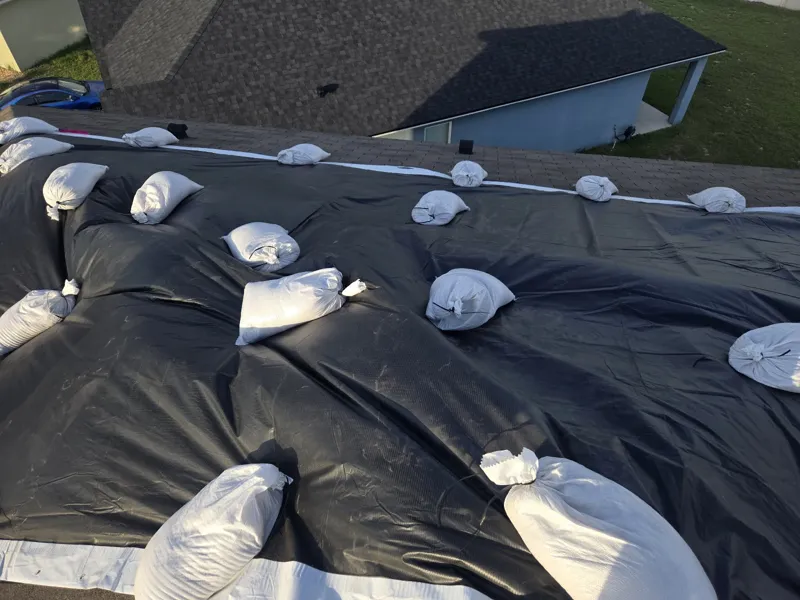
Two things matter more than the rest. Keep fasteners out of the damaged area and the path water takes down the slope, because, as Fixr's roof leak guide warns, the fasteners holding the boards down create new entry points for water. And remember that screws through the shingles will need repairing along with the original damage, so keep them to the boards and as few as the job allows.
Boards, screws or sandbags?
Each way of holding a tarp down trades something. Boards screwed through the roof hold best but add holes. Sandbags add no holes, but they can shift on a pitched roof and need checking after every storm. Nailing the tarp straight to the roof without boards is the one to avoid: the tarp tears out around each nail as soon as it flaps.
Our own installs are cut to the damage, battened along the edges with furring strips and fastened to structure with the penetrations kept out of the leak path, so the wind has nothing to grab. Where a quick, hole-free cover is the right call, the tarps in our job photos are held with sandbags.
Making a tarp last through Florida weather
A tarp that looks fine on a calm afternoon gets its real test two weeks later, when an afternoon thunderstorm brings 40 mph gusts. A loose tarp flogs itself to shreds, tears out its fasteners and lets water back in. In Central Florida that test comes all summer, not just when a hurricane is named.
- Check it after every storm, from the ground if you can see it. Look for lifted edges, a sagging pocket holding water, or a board that has worked loose.
- Don't let it become the roof. Bob Vila's guide says to leave a tarp on no longer than the manufacturer recommends, about 90 days, because the longer it stays, the more likely it is to tear or blow off. Sun breaks down plastic tarps fast.
- Plan the permanent repair now. A tarp buys time to get quotes and deal with insurance. It doesn't fix the roof.
When a roof needs to stay covered for months rather than weeks, we say so up front, build the install for that timeline and come back to re-secure it.
Tile, metal and flat roofs
Most do-it-yourself tarping advice assumes shingles. Other roofs change the job:
- Tile roofs crack under foot and under fasteners, and a careless tarp job can break more tiles than the storm did. Tile is a job for a crew that knows how to work it.
- Metal roofs are slick, and screwing through panels adds leaks. Even the federal Operation Blue Roof program reviews metal roofs case by case, and it leaves out flat roofs and clay, slate and asbestos tile entirely, according to the U.S. Army Corps of Engineers.
- Flat and low-slope roofs need a tarp that sheds water toward the drains instead of letting it pond on top of the damage. Our commercial roof tarping page covers how those are secured.
DIY tarp or professional tarp?
| Compared | Do it yourself | Professional crew |
|---|---|---|
| Best for | A small area on a low, dry, shingle roof | Two-story, steep, tile, metal or flat roofs, large areas, active storms |
| Safety | Your risk, often without fall protection | Crew trained and equipped for damaged roofs |
| Hold in wind | Depends on how the edges are anchored | Battened edges and anchoring planned around the leak path |
| Records for a claim | Your own photos | Before-and-after photos from us, yours to keep |
| Cost | Materials only | Quoted before work starts |
What a tarp job usually costs and who pays for it is in our guide to emergency roof tarping cost.
When to call us instead
Call (863) 204-2088 if water is already inside, the roof is too high or steep to work, a limb is on it, or weather is still coming. A person answers, asks what happened and gives you an honest arrival window.
We photograph the damage before we touch it, fit and anchor the tarp, and photograph it again when we're done. If what you need is a targeted emergency roof repair rather than a tarp, we tell you. For the full sequence after a leak, see how to repair a leaking roof.
We work from Winter Haven across Polk County, including Lakeland, Auburndale and Lake Wales, and out to Kissimmee, Bradenton and Sarasota. If you would rather not learn how to tarp a roof on a wet night, our 24/7 emergency roof tarping crew will do it for you.
FAQ
How do you tarp a roof?
Clear the debris, lay the tarp so it runs about 4 feet over the ridge, roll each edge around a 2x4 and screw the boards down so wind can't get under the tarp. Do it with a helper on a dry roof you can stand on safely, and keep fasteners out of the damaged area.
How far over the ridge should a roof tarp go?
Bob Vila's guide says about 4 feet over the peak, so water running down the far slope can't get under the tarp's top edge.
Can you tarp a roof without nails or screws?
Yes, with sandbags, which add no holes. They can shift on a pitched roof, so check the tarp after every storm. Boards screwed down hold better but add fasteners that will need repairing later.
How long can a tarp stay on a roof?
Treat it as weeks, not months. Bob Vila's guide puts typical manufacturer guidance at about 90 days, and Florida sun and afternoon storms wear tarps out. If the roof needs longer, the install has to be built for it and checked.
Should I tarp my roof in the rain?
No. A wet roof is slippery, and wind can catch the tarp and pull you off. Protect the inside of the house first, and call a crew if the roof has to be covered before the weather clears.
Can I tarp a tile or metal roof myself?
It's best not to. Tile cracks under foot and under fasteners, and metal is slick and leaks around new screws. Both need a crew that knows how to secure a tarp without adding damage.